The TLDR
Myth
Technological limitations
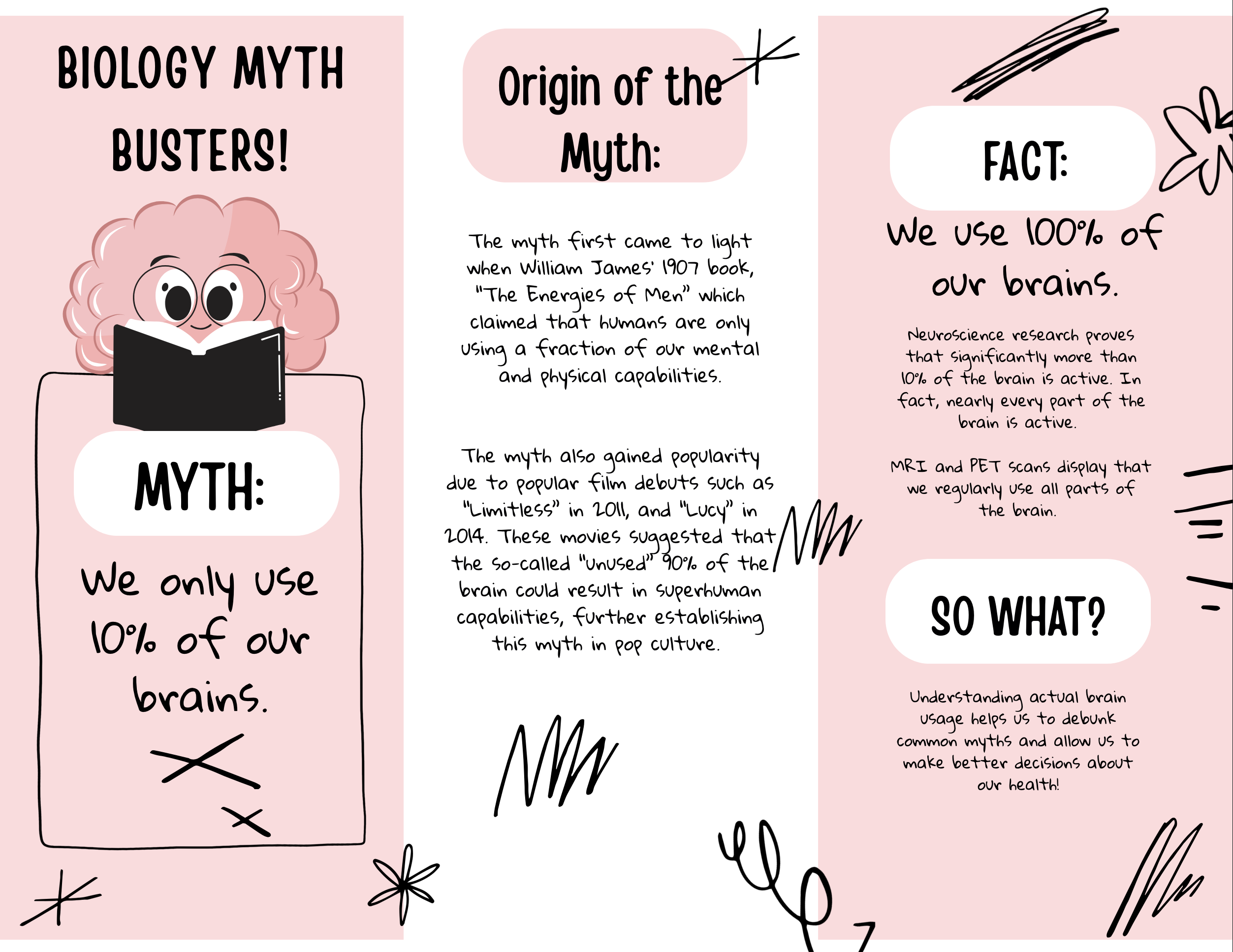
The myth that humans only utilize a small part of their brains gained popularity with early scientific explorations of brain function and scientists lacked the technology and abilities to capture how the brain truly worked. In 1907, William James, a pioneer in American psychology, suggested in his book “The Energies of Men” that we are using only a fraction of our mental and physical capabilities, which likely fueled this misconception.
Pop culture
Hollywood films, such as Lucy (2014) and Limitless (2011), perpetuated the myth that utilizing the "unused" 90% of the brain could result in superhuman abilities, thus embedding the concept into popular culture.
Incorrect comparisons
The myth that only 10% of the brain is used doesn’t have an exact origin. A reason this myth may have come to existence is because the lung, appendix, or kidney isn’t fully used to its full capacity. This is what most likely results in the myth that only 10% of the brain is used but that is false.
Timing
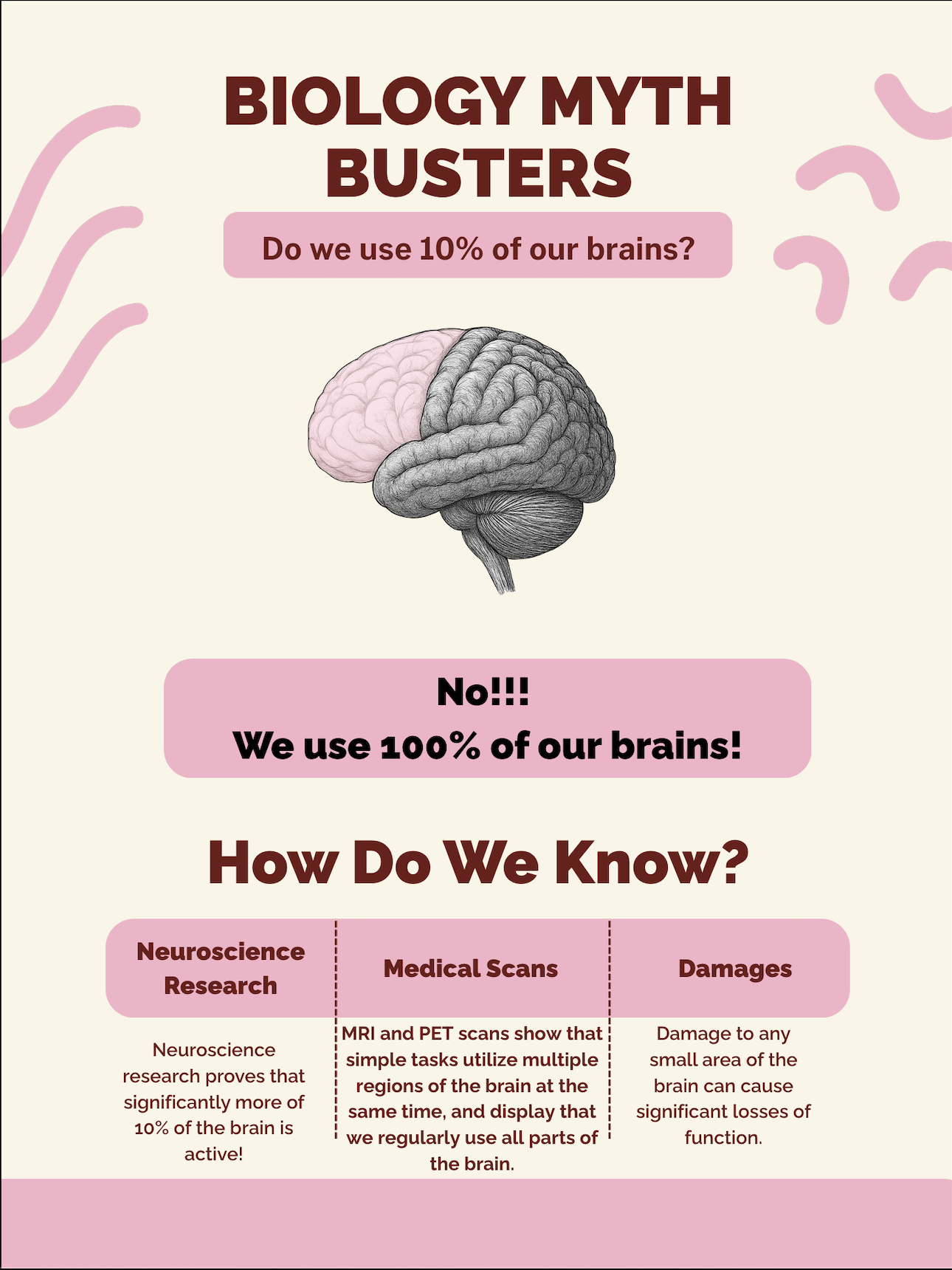
According to MRI and PET scans not every cell in the brain is used at the same time, but that does not mean only 10% of the brain is used. Every part of the brain is used, but not always at the same time which is also a huge misconception that causes people to believe that only 10% of the brain is used.
Reality
Most brain injuries affect you
If we only used that small portion of a brain, the majority of brain injuries would have little to no effect as they would be in parts of the brain with no purpose.
We can see it
Modern neuroscience research shows that nearly every part of the brain is active. Imaging techniques like fMRI and PET scans reveal that even the simplest tasks we perform such as reading, writing, or speaking all use multiple regions of the brain simultaneously.
What a waste it would be
Natural selection discourages the development of useless anatomical structures, like a head full of extra energy consuming tissue. If early humans devoted resources to growing and maintaining these large amounts of brain tissues, they would have been outcompeted by those responding to things more necessary for survival, like muscles for strength or hair for warmth. Quite literally anything would be more beneficial than having a skull full of useless tissue, unless the majority of it contributed to our proliferation.
This is widespread
Nearly two thirds of the general public, including almost HALF the population of teachers and even some neuroscientists (who research the brain for a living) believe this myth is true. That belief often stems from early misunderstandings of the brain, typically from a young age.
Importance
It Corrects Misconceptions About Intelligence
Proving the invalidity of this myth in turn correct misconceptions about intelligence and what the human brain is capable of. Myths like these lead people to think that they are not using their full potential. While really, everyone’s brain operates almost full capacity, using nearly every single part all the time. Understanding this idea allows people to appreciate intelligence and also understand that all of our brains are amazing things and it isn’t about “unlocking” new parts, it’s about using each and every aspect effectively.
It puts the brain's power into perspective
The brain consists of approximately 86 billion neurons that connect to form a massive network. That network is responsible for all functions, including emotion, memory, and even basic movement. Understanding the complexity and efficiency involved in using this whole neural network helps us appreciate the power of the human brain.
It Deepens Understanding of Brain Health and Recovery
Proving this myth wrong deepens people's understanding of brain health and recovery from injuries. Neuroscientists study how different injuries affect different parts of the brain and how the brain responds to it. The research being done helps improve treatments for injuries, mental health disorders, and diseases. Understanding that every aspect of the brain plays a role is what drives research to continue and progress.
It Shows That the Brain Is Always Active — Even at Rest
Contrary to the idea that this myth creates, that we have numerous unused parts of our brain, studies have shown that most of our brain even stays active when we are not focusing on a specific task. Even when our brain is at rest our brain continues to process information, consolidate memories, and spark creativity. This shows how proving this myth wrong reveals so many other amazing things about our brain and it’s capabilities. Not only is way more than 10% used, it's even mostly all used when we aren’t even awake.
Team
Jonah Morales jm227556@eid.utexas.edu
Kat Wilson kew3448@my.utexas.edu
Kayla Hehenberger kah5777@utexas.edu
Shashank Maruvada shashankm@my.utexas.edu
Social Media Posts
|
|
Works Cited
Veerakone, Rubina. “Do We Only Use 10 Percent of Our Brain?” MIT McGovern Institute, 26 Jan. 2024, mcgovern.mit.edu/2024/01/26/do-we-use-only-10-percent-of-our-brain/.
Patrick, Glanze. “Do We Really Use Only 10% of Our Brain? What Neuroscience Really Says about Brain Usage.” Science Times, 11 Nov. 2025, www.sciencetimes.com/articles/60744/20251111/do-we-really-use-only-10-our-brain-what-neuroscience-really-says-about-brain-usage.htm.
“Beyond the Myth That We Use Only 10 Percent of Our Brains.” Psychology Today, 2025, www.psychologytoday.com/us/blog/common-sense-science/202505/beyond-the-myth-that-we-use-only-10-percent-of-our-brains.
The Editors of Encyclopaedia Britannica. “Do We Really Use Only 10 Percent of Our Brain?” Encyclopædia Britannica, 2019, www.britannica.com/story/do-we-really-use-only-10-percent-of-our-brain.
Davis, Hannah. “Do Humans Only Use 10% of Their Brains? The Myth and the Science behind Brain Use.” Debunk the Myth, 13 July 2025, www.debunkthemyth.org/2025/07/13/do-humans-only-use-10-of-their-brains-the-myth-and-the-science-behind-brain-use/.
Sarish, Dineshkumar. "History Rewinded: Origins of the 10% Myth" Medium.com, 2025, medium.com/@neuro_nuggets/history-rewinded-origins-of-the-10-myth-23202a97866b.
Solan, Matthew. “You Don’t Say? Brain Space.” Harvard Health, 1 Oct. 2021, www.health.harvard.edu/mind-and-mood/you-dont-say-brain-space.